Devon · EX1-EX6
Drone survey in Exeter
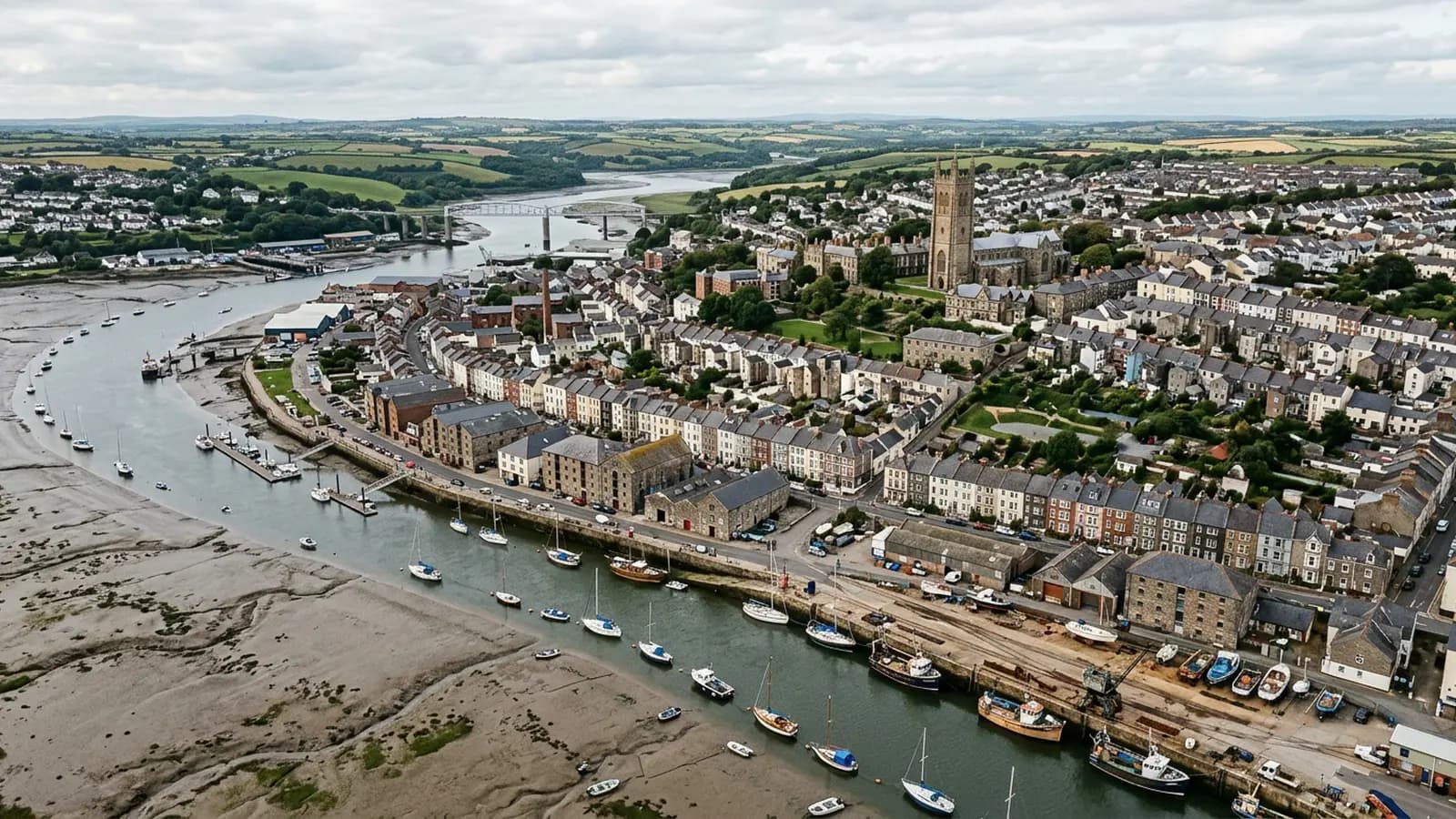
The city where the surveys are based, with a building stock that runs from Georgian terraces to last year's estates, and a river valley that keeps everything damp.
Four centuries of roof in one city
Exeter is unusual in how many different kinds of building sit within a few streets of each other. The older central quarters carry Georgian and Victorian terraces with natural slate, party walls and hidden valleys. The outer ring is post-war semis and estates under concrete interlocking tile. Around the university there are large blocks of purpose-built student accommodation with flat roofs and plant on top of them, and out towards Pinhoe the newest housing is barely finished.
Each of those has a different failure pattern, and a first survey is worth more when it starts from the right one. On a Victorian terrace the questions are usually about the valley between two pitches, the state of the party parapet and whether the front slates are original. On a 1970s estate house they are about ridge mortar, verge pointing and a flat roof over a back extension that nobody has looked at since it was built.
The valley is why things grow on your roof
The city sits on a low ridge above the tidal head of the Exe, with the ground dropping east into the Clyst valley and climbing west towards Haldon. Rainfall here is above the England average, and the valley holds damp air rather than letting it move through. The practical result is that north-facing slopes dry slowly and organic growth is persistent.
Moss is not automatically a problem, and a survey that treats every patch of it as a defect is not helping anybody. What matters is where it is holding water: in the laps of a slate roof it lifts the tail and lets water track backwards, and in a gutter or a valley it turns into a dam. A set of photographs from above shows the difference between a green roof and a blocked one, which is the thing you cannot judge from the pavement.
Flying in the city, and the airport to the east
Most Exeter addresses are straightforward to fly. The complications are ordinary urban ones: finding a few square metres of clear ground to take off from on a street with no front gardens, working over a terrace where the neighbours are three metres away, and picking a time of day when a school run is not passing the gate.
The one specifically local factor is Exeter Airport, which sits east of the city near Clyst Honiton. Addresses close to it need the airspace question settled before a date is offered rather than on the morning. That is a planning matter and it is not usually an obstacle, but it is the reason an EX5 job near the runway takes longer to book than an EX4 job in St Thomas.
What people here use the report for
Exeter has a large rented and managed sector, so a good share of the enquiries come from landlords and managing agents who need to know the condition of something they do not live in. A dated photographic record of a roof is worth having on a file for exactly that reason, and it settles arguments about when a defect appeared.
The other big use is the stalled sale. The city moves a lot of property, and a buyer's survey flagging a roof is one of the commonest reasons a sale sits still. Photographs of the actual roof, taken this week, generally move it one way or the other inside a fortnight.
Behind the survey
What Exeter clients are actually buying
CAA registered
Registered with the Civil Aviation Authority as an operator, with both an Operator ID and a Flyer ID held. Anybody flying a camera drone for you should hold both.
A2 Certificate of Competency
The qualification that covers flying closer to buildings and to people than the basic rules allow. It is not a GVC and this site does not claim one.
Insured with Coverdrone
Commercial flights are covered by a Coverdrone policy. A copy of the certificate is available on request, and most managing agents will ask for it.
One named surveyor
Sam Hembury plans and flies every job himself and writes up every report. There is no crew and no subcontractor, so the person you speak to is the person who turns up.
DJI Mavic 4 Pro
A 100 megapixel Hasselblad camera and 6K video. That resolution is the reason a cracked mortar joint is readable in a photograph taken from twenty metres away.
DJI Mavic 2 Enterprise Advanced
Carries a 640 by 512 radiometric thermal camera alongside the ordinary one, which is a different job: heat and moisture rather than condition.
Report within 48 hours
The written report follows the flight within 48 hours. It is a process commitment rather than a promise about what the report will find.
Construction background
The reports are written by somebody who worked in construction before flying, so a defect is described in the words a builder or a roofer will use back to you.
Nearby
Also covered around Exeter
- CranbrookDevon's newest town, still building out phase by phase, where the survey questions are about workmanship and warranties rather than about age and wear.
- TopshamA listed estuary town where the roofs are old, the salt air never lets up and the streets are far too tight to get a scaffold anywhere useful.
- ExmouthTwo miles of open seafront and unbroken salt-laden south-westerlies, which corrode fixings faster than anywhere inland and lift ridges and verges every winter.
- CreditonA market town in a red sandstone valley surrounded by working farms, where thatch ridges and north-facing slate take the brunt of Atlantic weather.
- CullomptonA Culm valley town on flat ground beside the M5, holding damp and frost, with medieval fabric, thatch and a lot of late twentieth century estate housing.
- Newton AbbotRailway-era terraces in large numbers on damp low ground by the Teign, plus big industrial spans on the trading estates that nobody can walk on safely.
See what it costs
Get a quote in Exeter
Send the address and what is worrying you. Sam Hembury will come back with a fixed price and the next slot that suits the weather.