Who turns up
One surveyor, one van, and a background in building things
Construction first, flying second
The route into this was through building work rather than through photography. Years on sites and on jobs where the awkward part was always the bit nobody could reach: the back of a chimney stack, the middle of a flat roof, the valley between two pitches on a house with no safe ladder position.
The traditional answers to that were a scaffold, a tower, a cherry picker or somebody taking a risk. All of them cost money and two of them cost a lot of it, and none of them are worth doing just to find out whether there is a problem at all. An aircraft with a good camera answers that question in half an hour without anything touching the building.
The construction background is the reason the reports read the way they do. A photograph of a defect is only half the job. What most people need is somebody saying what it is in the words the next trade will use, so that a roofer reading the report knows immediately what he is quoting for, and so that you are not the one having to explain it.
It also means the reports are careful about what they do not say. A drone survey does not diagnose what is going on inside a wall or under a covering, and a report that pretends otherwise is worse than no report. Where something needs opening up, or needs a different trade entirely, that is what it says.
On the record
Registrations, kit and cover
CAA registered
Registered with the Civil Aviation Authority as an operator, with both an Operator ID and a Flyer ID held. Anybody flying a camera drone for you should hold both.
A2 Certificate of Competency
The qualification that covers flying closer to buildings and to people than the basic rules allow. It is not a GVC and this site does not claim one.
Insured with Coverdrone
Commercial flights are covered by a Coverdrone policy. A copy of the certificate is available on request, and most managing agents will ask for it.
One named surveyor
Sam Hembury plans and flies every job himself and writes up every report. There is no crew and no subcontractor, so the person you speak to is the person who turns up.
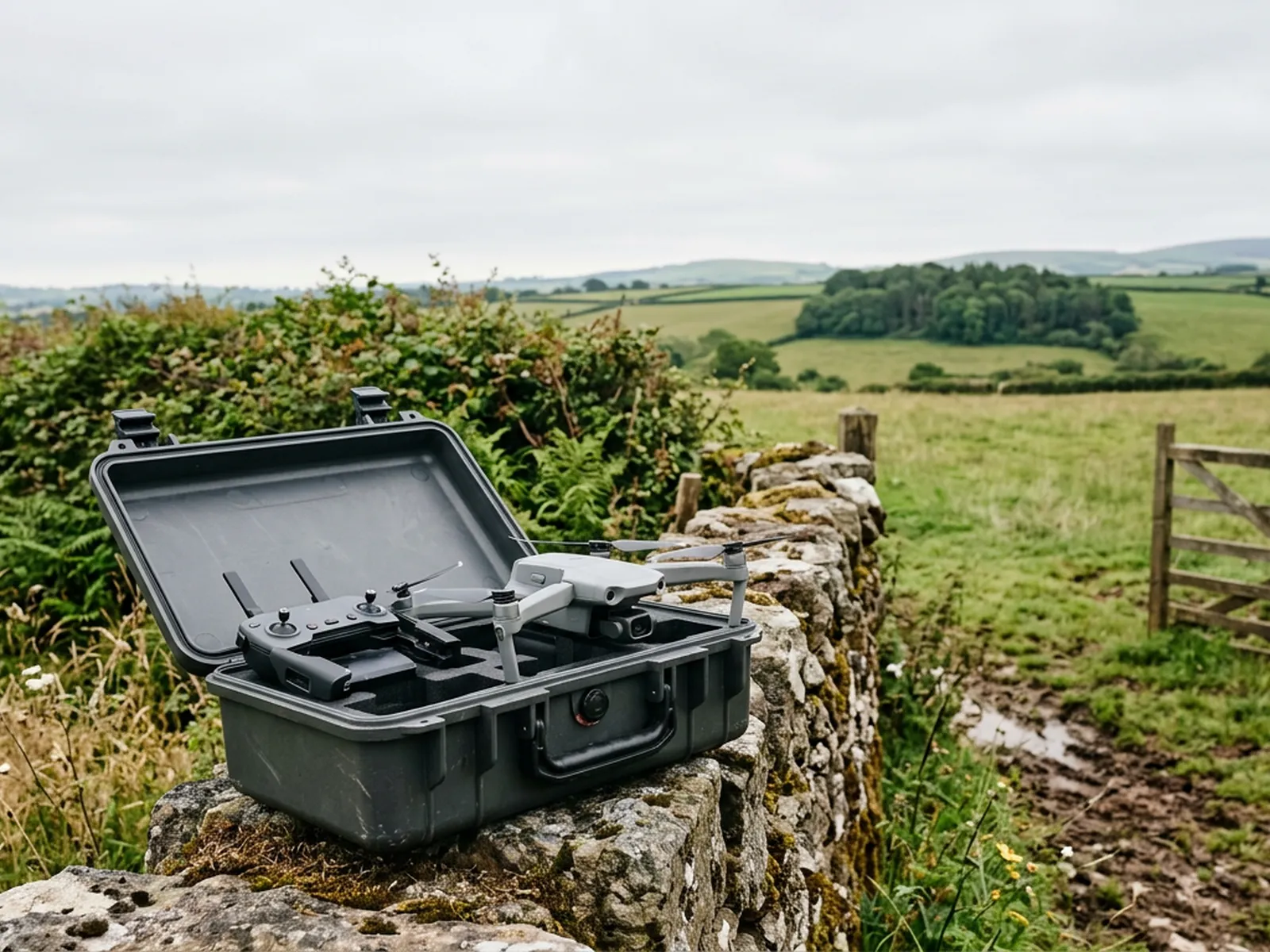
DJI Mavic 4 Pro
A 100 megapixel Hasselblad camera and 6K video. That resolution is the reason a cracked mortar joint is readable in a photograph taken from twenty metres away.
DJI Mavic 2 Enterprise Advanced
Carries a 640 by 512 radiometric thermal camera alongside the ordinary one, which is a different job: heat and moisture rather than condition.
Report within 48 hours
The written report follows the flight within 48 hours. It is a process commitment rather than a promise about what the report will find.
Construction background
The reports are written by somebody who worked in construction before flying, so a defect is described in the words a builder or a roofer will use back to you.
DJI Mavic 4 Pro
100 megapixel Hasselblad camera and 6K video.
DJI Mavic 2 Enterprise Advanced
640 by 512 radiometric thermal camera alongside the visual camera.
How we work
Three things that do not change
The price is agreed first
A fixed price per survey, worked out from the address and the job before anybody travels. No hourly rate running while you watch, and no revision afterwards unless what is on site turns out not to be what was described.
The record is yours
The photographs and the report belong to you and you can send them to anybody: a roofer, an insurer, a solicitor, a managing agent. Nothing is held back to keep you coming back.
The limits are stated
Every report says what could not be seen on the day, whether that was a covered section, a shaded elevation or a slope hidden by a tree. Knowing where the gaps are is part of the evidence.
See what it costs
Get a quote with Drone Survey
Tell us the address and what you need looking at. Sam Hembury will come back with a fixed price and the next available slot.